MonMon Masters
- 4.5
- Rating
- 10.00K
- Installs
- Free
- Price

 Analysis by App-foxy
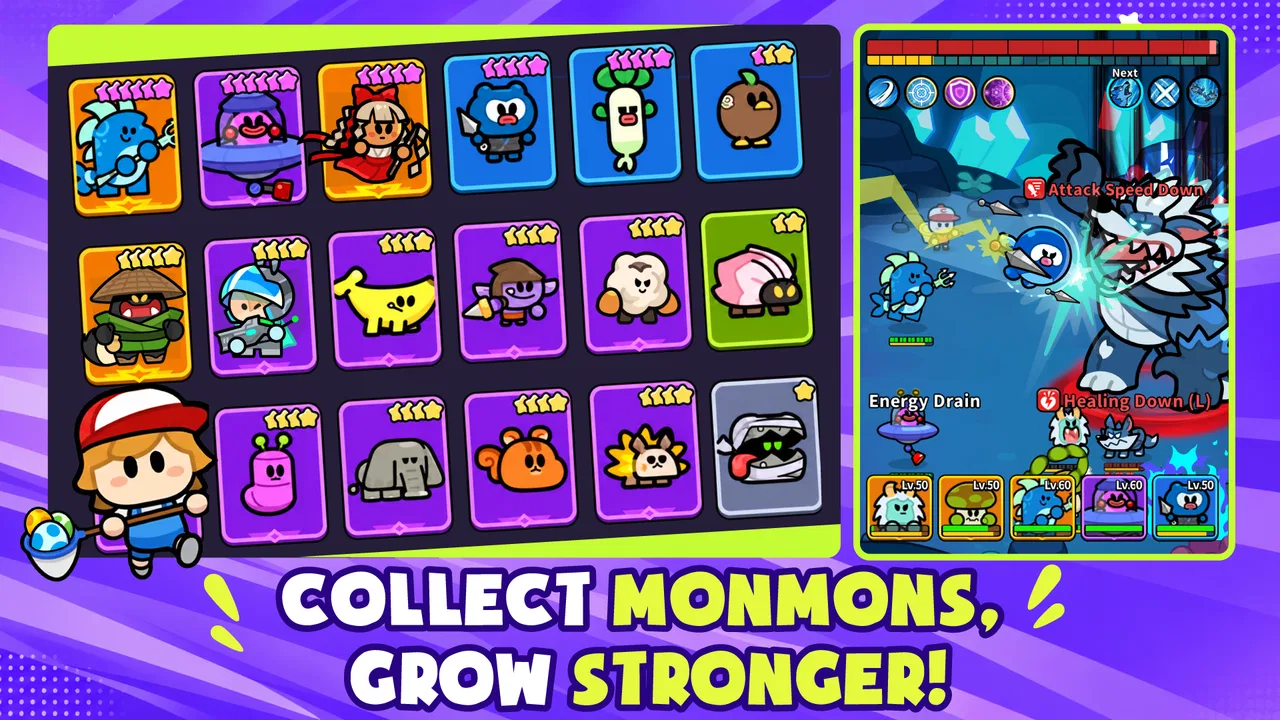
I approached MonMon Masters as a role-playing game built around one central promise: gathering MonMons, helping them grow, and taking them into arena battles. That focus matters because it makes the game feel less like a broad adventure with a collection feature added on top and more like a compact team-building experience. I spent my time thinking about the decisions that sit between receiving a new creature and actually trusting it in a fight: which one deserves attention, how much effort to invest, and whether a familiar choice is still useful when a stronger-looking option appears.
That loop is easy to understand, which is a major reason the game feels approachable. You do not need to learn a complicated role-playing vocabulary before making progress. The appeal is in gradually turning a loose collection into a group that feels deliberately chosen. For players who enjoy watching a roster develop and then testing it in competitive encounters, that is a satisfying foundation. For anyone expecting a large, story-heavy role-playing adventure, the emphasis may feel narrower.
Why evolving a collection is the real attraction
The most interesting capability here is the relationship between collecting and evolving. A newly obtained MonMon is not simply another entry to admire and forget. It represents a possible future team member, and that changes how I look at every addition. Even when a creature is not immediately useful, it can still matter as part of the longer process of building a stronger roster.
You May Also Like

 AccuWeather: Weather Radar
AccuWeather Review: A Quick, Clear Forecast for Everyday Decisions
For everyday plans, the best forecast is the one you can understand quickly. AccuWeather makes rain timing, radar, and local conditions easy to act on, with a few trade-offs.

 Hill Climb Racing
Why Hill Climb Racing Still Turns Crashes Into One More Run
A tiny car, a bumpy hill and one more upgrade: Hill Climb Racing keeps resurfacing because its simple chaos makes every near-miss feel personal.

 AliExpress - Shopping App
AliExpress Makes Global Shopping Feel Personal, but Shoppers Bear the Risk
AliExpress turns a global marketplace into a pocket-sized discovery engine. Its reach is useful, its shopping loop compelling, and its trade-offs easy to miss.

 Lords Mobile: Kingdom Wars
Lords Mobile Is a Kingdom-Building Routine, Not a Quick Match
A case-by-case verdict on the building, battles, device demands, and social commitments that make Lords Mobile rewarding for some players and exhausting for others.

 PDF Scanner app - TapScanner
TapScanner Makes Paperwork Easier to Capture, Check, and Share
TapScanner makes scanning with a phone feel less like a rescue operation and more like a dependable step in getting work done. Its capture tools are useful, though not flawless.

 Block Blast!
 Shows How Much a Puzzle Game Can Leave Out
A quiet grid game shows why puzzle players increasingly value instant clarity, repeatable skill and low-pressure play—and where the genre still needs to catch up.
More From Our News Desk
View All News


In practice, this creates a useful tension between variety and commitment. Collecting encourages experimentation, while evolution encourages investment. I found that the best way to approach the game was not to treat every new MonMon as an automatic upgrade. Instead, I would ask whether it suited the kind of arena team I wanted to build and whether improving it would make my current lineup more dependable.
The important decision is not collecting everything; it is deciding what deserves your limited attention. That is where the game’s role-playing identity becomes more meaningful. The collection is the starting point, but the personal value comes from shaping it. A player who enjoys making small strategic choices will get more from this loop than someone who only wants to unlock creatures as quickly as possible.
The arena gives those choices a purpose. Without battles, evolution would mostly be a visual or completion-focused activity. Here, the promise of conquering arenas gives the process direction. I could take a more patient approach, improve a dependable core, and then use the results to judge whether my decisions were working. That feedback makes progression feel more connected to play rather than just to accumulation.
How the collection loop feels during ordinary play
The game is easiest to appreciate in short sessions. I can imagine opening it while waiting for transport, taking care of a small piece of progression, and leaving with a clearer idea of which MonMon I want to develop next. That kind of session works well because the main objective is understandable even when I do not have time to settle into a long adventure.
A realistic everyday routine would be to check the roster after work, select one MonMon that has been sitting unused, and use the next arena attempt to see whether it has a practical role. The useful part is not simply winning. It is learning whether the creature fits the team better than the option it replaced. That makes a short battle feel like a test rather than a disconnected activity.
I also recommend resisting the urge to spread attention evenly across the entire collection. In a game centered on evolution, trying to improve everything at once can make progress feel diluted. A smaller group gives each decision more weight and makes it easier to notice what changed after an upgrade. Once that group feels stable, expanding the roster becomes more purposeful.
This is one of the less obvious strengths of the concept: the collection can function as a planning tool, not just a checklist. I found more satisfaction in comparing possible roles and building around a chosen direction than in treating every available MonMon as equally important. That approach also helps reduce the feeling of being overwhelmed when the roster begins to grow.
What to consider before committing to an arena team
When I prepare a team, I would begin with reliability rather than novelty. A newly acquired MonMon may look exciting, but an established choice that has already received attention can be more useful for the next arena attempt. This is a simple habit, yet it prevents a common mistake in collection games: constantly replacing a functioning team before understanding why it works.
My second recommendation is to change one meaningful part of the lineup at a time. If I evolve several creatures or replace the entire team together, it becomes difficult to tell which decision helped. Testing a single change keeps the feedback clear. It also makes defeats less frustrating because I have a specific adjustment to consider instead of a completely uncertain roster.
The third is to treat arena attempts as information. A loss does not automatically mean the whole team is poor. It may show that one MonMon is not ready, that the lineup lacks balance, or that a different evolution path would better support the group. This mindset is especially valuable for players who enjoy role-playing systems but dislike repeating battles without understanding the reason.
Because the game is free to start, it is reasonable to try this process without making a financial commitment. The listed in-app purchase range runs from less than a dollar to nearly a hundred dollars per item, so I would personally decide early whether I am comfortable progressing at a relaxed pace or spending to accelerate parts of the experience. The free entry is welcoming, but the presence of purchases means the game is better suited to players who can set their own spending boundary.
The best setting for MonMon Masters
The strongest scenario is a player who wants a lightweight creature-collection role-playing game that can be revisited regularly. I would recommend it to someone who enjoys checking a roster, making a focused improvement, and testing that improvement in arenas rather than following a long cinematic campaign. It is particularly suitable for people who like gradual progress and do not need every session to introduce a major new event.
Imagine having a short break and wanting something more thoughtful than a purely reflex-based game. You can review the MonMons you have collected, choose one that supports your current plan, and use an arena battle to evaluate the decision. That gives the session a clear beginning and end. The game does not need to dominate your evening to feel useful; its central loop works precisely because it can fit around other activities.
It can also work for friends who enjoy comparing approaches, even if they do not build teams in the same way. One player may favor a dependable core, while another may prefer experimenting with less obvious choices. Since the appeal comes from the relationship between collection, evolution, and arenas, there is room for personal style rather than one obvious way to value the roster.
The age rating of Everyone makes the game broadly approachable from a content perspective. I would still encourage younger players to understand that optional purchases are available, especially because the individual purchase range reaches from $0.99 to $99.99. The game’s accessibility is a positive, but responsible spending habits remain important whenever a free game includes paid items.
Where the game asks for patience
The same focus that gives MonMon Masters its identity can also limit its appeal. If you prefer a role-playing game with extensive exploration, a large narrative, or a constant stream of different activities, this may feel too concentrated on roster growth and arena preparation. I would choose a broader adventure game instead when the main goal is discovering a world rather than refining a collection.
There is also a risk of repetition for players who do not enjoy incremental improvement. Collecting and evolving are rewarding when small changes feel meaningful, but they can seem slow if you want immediate variety or dramatic power jumps. The game asks you to care about the process of building a team, not merely the result of reaching the next milestone.
Another trade-off is the pressure created by optional purchases. I appreciate that the game can be tried for free, but a player who is easily tempted by progression offers should decide on a budget before becoming invested in a particular roster. My advice is to play long enough to learn whether the core loop itself is enjoyable. If collecting, evolving, and testing MonMons already feels satisfying, the game has a stronger chance of holding attention without turning every improvement into a purchase decision.
Device compatibility is also worth checking before installing. The current version is 1.0.17 and requires Android 6.0 or later. That makes it accessible to many older Android devices, although the experience can still depend on how well a particular phone handles the game. I would keep expectations practical on older hardware and avoid judging the game solely by the first few minutes if loading or responsiveness feels less smooth than expected.
How it compares with familiar alternatives
Compared with a traditional monster-collecting adventure, this game appears more focused on the roster-to-arena relationship. A classic adventure usually gives equal importance to traveling, discovering locations, meeting characters, and progressing through a story. Here, I would come for the collection and stay for the decisions about evolution and arena readiness.
Compared with a straightforward arena battler, the collection layer gives my choices more history. In a battle-first game, I may care mainly about immediate performance. In MonMon Masters, I am encouraged to think about how a MonMon reached its current role and whether further development is worthwhile. That makes preparation more personal, although it also means players who want instant competitive action may find the buildup slower.
It also differs from a purely idle role-playing game in the way I approach progress. An idle game can be satisfying when I want rewards to accumulate with minimal involvement. This title is more appealing when I want to make active judgments about which MonMons to develop and how to use them in arenas. If I am looking for something I can leave alone for long periods, another style may suit me better.
My practical comparison is simple: choose MonMon Masters when the collection itself is part of the fun, choose a larger role-playing adventure when exploration and story matter most, and choose a battle-focused alternative when you want to spend nearly all your time in direct competition. The game occupies a clear middle ground, but it is not trying to be all three at once.
Who will get the most from the experience
I think the best audience is made up of players who enjoy making measured improvements. You do not need to be an expert strategist, but you should like asking whether a new MonMon genuinely improves your team. The game rewards attention to progression choices more than random switching, and that gives patient players a noticeable advantage in enjoyment.
It is also a good match for people who want a free role-playing game they can sample without a large initial commitment. The store rating sits at an average of 4.5 from around 481 ratings, while the game has passed 10,000 installs. Those figures suggest a small but positive early audience, and they fit my impression of a focused title that is still finding its place rather than an enormous established platform.
PLAYHARD STUDIO has kept the idea easy to explain: collect MonMons, develop the ones that matter to you, and use them to pursue arena progress. That clarity is valuable. I never had to invent a reason to care about the roster because the arena gives every improvement a practical destination.
I would be more cautious recommending it to someone who dislikes repeating battles, managing a growing collection, or making progress in small steps. I would also steer away players who want a completely purchase-free experience, since optional items can cost from $0.99 to $99.99 each. Those are not deal-breakers for everyone, but they change the kind of player who will feel comfortable over time.
My recommendation after spending time with it
MonMon Masters works best when I treat it as a focused team-building game rather than a complete role-playing world. Its standout capability is the way collecting and evolving feed directly into arena decisions. That connection gives ordinary roster management a reason to exist and turns short sessions into useful experiments.
My strongest advice is to begin slowly: build a small core, improve one choice at a time, and use arena results to guide the next decision. Do not assume the newest MonMon is automatically the right one, and do not spend before deciding whether the basic collection-and-evolution loop is enjoyable on its own. Those habits make the game clearer and help keep its optional purchases in perspective.
For me, the result is an approachable free role-playing game with a specific appeal. It will not replace a story-rich adventure or a battle-only competitive title, but it does offer a satisfying middle ground for players who like turning a collection into a team. If that sounds like the kind of progress you enjoy, MonMon Masters is worth trying. Its strongest moments come when a small evolution choice changes how confidently I approach the next arena.
FAQs for MonMon Masters
01What is MonMon Masters and what can I expect from it?
MonMon Masters is a captivating creature-collection and battling game available on Android and iOS. In this game, players explore vibrant worlds, collect various MonMons, and strategize in battles to become the ultimate MonMon Master. Expect engaging gameplay, frequent updates, and a mix of strategy and adventure elements.
02Is MonMon Masters free to play, and are there in-app purchases?
MonMon Masters is free to download and play, offering a comprehensive gaming experience without any initial cost. However, the game includes in-app purchases that can enhance gameplay, such as special items, exclusive MonMons, and cosmetic upgrades. Players can enjoy the game fully without spending money, but these purchases can provide an advantage.
03What are the system requirements for MonMon Masters?
To run MonMon Masters smoothly, your device must meet certain system requirements. For Android users, a device running Android 5.0 or later is recommended. iOS users should have iOS 10.0 or later. Adequate storage space and a stable internet connection are also essential for optimal gameplay.
04Does MonMon Masters require an internet connection?
Yes, MonMon Masters requires a stable internet connection to function properly. Features like real-time battles, updates, and social interactions depend on connectivity. While some offline elements exist, a network connection enhances the overall experience, ensuring access to all game modes and features.
05How does the multiplayer aspect of MonMon Masters work?
MonMon Masters offers a robust multiplayer mode where players can engage in real-time battles against others worldwide. This feature allows for competitive play, ranking systems, and the ability to join or create guilds. Multiplayer interactions enhance the strategic depth and provide a social element, making the game even more engaging.
Pros
- Engaging gameplay with strategic depth.
- Vibrant graphics enhance the experience.
- Diverse range of monsters to collect.
- Regular updates with new content.
- Intuitive controls for easy play.
Cons
- In-app purchases can be costly.
- Requires a stable internet connection.
- Occasional lag on older devices.
- Progression can feel slow at times.
- Limited offline functionality.

MonMon Masters
Gallery